Hegemonic Patterning Officially Justifies The Collapse of Boyfriend Culture
A case study on the commodification of commodification, and how this emergent world order is scaffolded by the declining economic and symbolic centrality of men

Editor’s note: We’re baaaaaaack ;). I’ve been exercising max discernment, thus, have only been willing to bring something groundbreaking to you…. that I believe rivals our previous paywalled letter: how ‘the commodification of manners’ might emerge as the next status symbol. Writing the piece below truuuuly made me feel alive. I hope you enjoy it too!!!!!


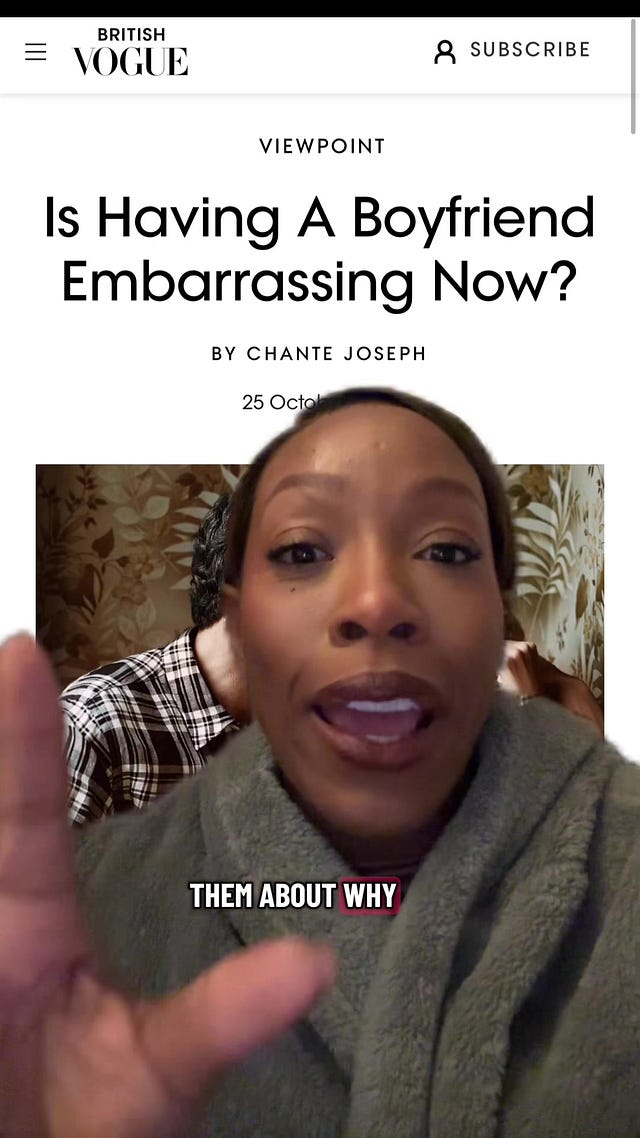
This week, something enormous happened. Journalist Chante Joseph wrote a viral (and brilliant) piece in British Vogue entitled: “Is Having A Boyfriend Embarrassing Now?” And while it was met with some trad-wife pilled commentary, I was SHOCKED to see the enormity of comments and organic posts (on tiktok/instagram) that are PRO the anti-boyfriend sentiment that Chante presents. '
 Tiktok failed to load.
Enable 3rd party cookies or use another browser


For scale — Chante’s video (posted 3 days ago) received 2.8M views and 465K likes (with 4K comments/52K saves/46K SHARES); another TikTok creator shared the article alongside the caption: this is the content I buy magazines for, and it received 1.9M views and 353K likes; a smaller creator simply mentioned the article in on-screen text and it became one of her most viral videos — 1.7M views and 421K likes… I could go on and on and on and on…
Chante’s piece concluded with the following sentiment:
“Obviously there’s no shame in falling in love. But there’s also no shame in trying and failing to find it – or not trying at all. And as long as we’re openly re-thinking and criticising heteronormativity, “having a boyfriend” will remain a somewhat fragile or even contentious concept within public life. This is also happening alongside a wave of women reclaiming and romanticising their single life. Where being single was once a cautionary tale (you’ll end up a “spinster” with loads of cats), it is now becoming a desirable and coveted status, another nail in the coffin of a centuries-old heterosexual fairytale that never really benefitted women to begin with.”
Here, she skillfully leads readers to subtly question if male proximity, once a form of symbolic capital, might now be a liability…. a groundbreaking line of questioning that begs to be probed deeper (in an academia-adjacent way). Which… is our calling card over here.
And as wise people have said for centuries, if you want to know what’s really happening— follow the money. To which I say: gladly.
Unearthing the Commodification of Commodification
Like angels harkening from the sky, the concurrent timing on this stuff is.. nuts. Last week, the influencer monetization + curational startup ShopMy officially became a unicorn (raising $70M on a $1.5B valuation).
When I incubated the research arm of a VC within my strategy team at a FAANG company (none of these words are in the Bible), my job was partly focused on spotting and tracking inflection points + extracting complex narratives across the startup ecosystem to paint an accurate picture of What’s Next for my two CEOs. If I were still there, I know I’d have gotten an exec text on this raise, not only bc Big Fat Raises matter… but because leaders are increasingly interested in the ones that have nothing to do with AI.
I should note that I am ALSO saying This Matters as someone who was bullish enough to invest in ShopMy — for me, the why is a bit more personal, but no less exacting: their business model corroborates the business and economic justification of influence. Even better — it’s reliable, repeatable, and scalable.
Their raise is less about flaming the embers of #girlboss culture, and far more about corroborating a very important thesis: that influence, largely built and sustained by women, is a legitimate economic engine. I mean, according to NIQ in 2024, women around the world will control 75% of discretionary spending in the next 5 years; women currently influence 70-80% of all consumer spending. Contextualized within ShopMy’s valuation… you start to see affirmation of a nascent shift: the commodification of commodification.
Finally, we can exist in a world where women are getting rich off of making the economy rich. I can’t even breathe as I type because there’s so much insane theory to unpack what! this! means!! within the context of the consumer landscape… alongside some STRONG theory-backed discovery on What’s Up Next if you’re a brand/founder/investor algjaljfalkfjalfalkajf.